
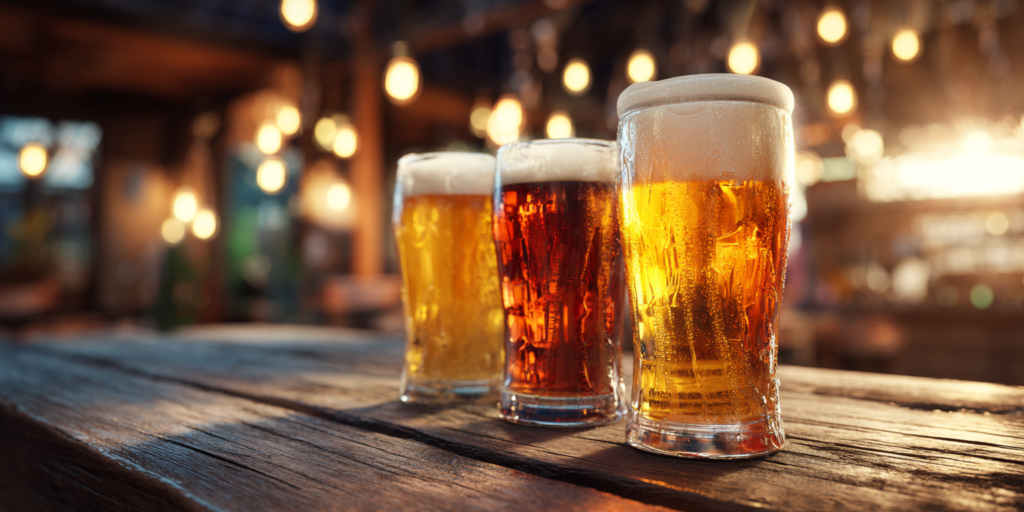
BeerBeer Styles Explained: Lager vs Ale vs IPA has fascinated humans for centuries, offering a rich tapestry of styles, flavors, and brewing traditions. Among the most discussed and often misunderstood are lagers, ales, and IPAs. Understanding these beer types not only helps you choose your next pint wisely but also deepens your appreciation for brewing craft.
Table of Contents
Understanding the Main Beer Families
Beer Styles Explained: Lager vs Ale vs IPA
All beers fall broadly into two families: ales and lagers. The distinction lies primarily in the yeast type and fermentation process.
Beer Styles Explained: Lager vs Ale vs IPA
Ales have been brewed for thousands of years. They use top-fermenting yeast (Saccharomyces cerevisiae) that thrives at warmer temperatures between 60–75°F. This process creates fruity, aromatic, and full-bodied flavors.
Common ale styles include:
- Pale Ale
- Brown Ale
- Porter
- Stout
Learn more about classic ale pairings and recipes at Belicimo’s Food & Drink Guide.
Lager: Crisp and Clean Perfection
In contrast, lagers are brewed with bottom-fermenting yeast (Saccharomyces pastorianus) at cooler temperatures between 45–55°F. The result is a crisper, smoother, and cleaner-tasting beer.
Popular lager styles include:
- Pilsner
- Helles
- Dunkel
- Bock
Lagers are the world’s most consumed beer type — refreshing, golden, and perfect for any occasion.
IPA: A Bold Subcategory of Ales Beer Styles Explained: Lager vs Ale vs IPA
Beer Styles Explained: Lager vs Ale vs IPA
Beer is one of the world’s oldest and most beloved beverages, enjoyed in countless forms — from crisp lagers to complex ales and bold IPAs. Yet, even among beer enthusiasts, confusion often arises when distinguishing these main styles. What exactly separates a lager from an ale, and where does the IPA fit into this brewing family?
Understanding the difference between these beer types helps you appreciate their craft, flavor, and history. Whether you’re a casual drinker or a curious home brewer, this guide breaks down beer styles explained: lager vs ale vs IPA in clear, simple terms.
The Two Main Beer Families
At its core, every beer belongs to one of two main families — ales and lagers. The distinction lies in the type of yeast used and the temperature at which fermentation occurs. These two variables completely change how a beer tastes, looks, and feels.
Ale: The Original Beer Style
Ales are the oldest known form of beer, with origins tracing back thousands of years. Long before refrigeration existed, brewers relied on top-fermenting yeast (Saccharomyces cerevisiae) that worked best in warmer temperatures between 60–75°F (15–24°C).
This process encourages the yeast to rise to the top of the fermentation vessel and produces rich, fruity, and complex flavors.
Common characteristics of ales include:
- Fruity esters such as banana, pear, or apple
- Fuller body and deeper malt flavor
- Shorter fermentation time
- Warm, aromatic taste
Ales tend to be more robust and flavorful than lagers. This style includes several subtypes, each offering unique nuances.
Popular Ale Styles:
- Pale Ale: Balanced malt and hops, amber in color.
- Brown Ale: Smooth, nutty, and caramel-like.
- Porter: Dark, roasted malt flavor with chocolate hints.
- Stout: Rich, creamy texture; often coffee-flavored.
- IPA (India Pale Ale): A hop-forward ale known for strong aroma and bitterness.
Learn more about pairing classic ales with foods at Belicimo’s Food & Drink Guide.
The History Behind Ales
Historically, ale was the default beer in Europe for centuries. In medieval England, “ale” was brewed without hops, while “beer” referred to hopped varieties introduced from the Netherlands. Over time, the line blurred, and both terms became interchangeable in casual conversation.
Ales continue to thrive today because of their bold taste profiles and creative potential. Modern craft brewers often experiment with yeast strains, fruits, and spices to create new ale variations.
Whether you prefer a smooth brown ale or a bitter pale ale, each sip tells a story of tradition meeting innovation.
Lager: Clean, Crisp, and Refreshing
If ales are known for complexity, lagers are celebrated for clarity and smoothness. Unlike ales, lagers use bottom-fermenting yeast (Saccharomyces pastorianus) that thrives at cooler temperatures between 45–55°F (7–13°C).
This colder, slower fermentation results in fewer fruity esters and a crisp, clean flavor. The yeast settles at the bottom of the tank, producing a more polished and refined beer.
Lager Characteristics:
- Clean, light, and balanced flavor
- Golden to pale straw color
- Subtle hop bitterness
- Smooth finish with moderate carbonation
- Longer fermentation time (cold conditioning or “lagering”)
Popular Lager Styles:
- Pilsner: Light and floral with a mild hop bite.
- Helles: Soft malt sweetness and golden hue.
- Dunkel: Dark, malty lager with caramel tones.
- Bock: Strong, toasty lager with higher alcohol content.
Learn more about refreshing beer pairings in Belicimo’s Drinks Section. Beer Styles Explained: Lager vs Ale vs IPA
Beer is one of the world’s oldest and most beloved beverages, enjoyed in countless forms — from crisp lagers to complex ales and bold IPAs. Yet, even among beer enthusiasts, confusion often arises when distinguishing these main styles. What exactly separates a lager from an ale, and where does the IPA fit into this brewing family?
Understanding the difference between these beer types helps you appreciate their craft, flavor, and history. Whether you’re a casual drinker or a curious home brewer, this guide breaks down beer styles explained: lager vs ale vs IPA in clear, simple terms.
The Two Main Beer Families
At its core, every beer belongs to one of two main families — ales and lagers. The distinction lies in the type of yeast used and the temperature at which fermentation occurs. These two variables completely change how a beer tastes, looks, and feels.
Ale: The Original Beer Style
Ales are the oldest known form of beer, with origins tracing back thousands of years. Long before refrigeration existed, brewers relied on top-fermenting yeast (Saccharomyces cerevisiae) that worked best in warmer temperatures between 60–75°F (15–24°C).
This process encourages the yeast to rise to the top of the fermentation vessel and produces rich, fruity, and complex flavors.
Common characteristics of ales include:
- Fruity esters such as banana, pear, or apple
- Fuller body and deeper malt flavor
- Shorter fermentation time
- Warm, aromatic taste
Ales tend to be more robust and flavorful than lagers. This style includes several subtypes, each offering unique nuances.
Popular Ale Styles:
- Pale Ale: Balanced malt and hops, amber in color.
- Brown Ale: Smooth, nutty, and caramel-like.
- Porter: Dark, roasted malt flavor with chocolate hints.
- Stout: Rich, creamy texture; often coffee-flavored.
- IPA (India Pale Ale): A hop-forward ale known for strong aroma and bitterness.
Learn more about pairing classic ales with foods at Belicimo’s Food & Drink Guide.
The History Behind Ales
Historically, ale was the default beer in Europe for centuries. In medieval England, “ale” was brewed without hops, while “beer” referred to hopped varieties introduced from the Netherlands. Over time, the line blurred, and both terms became interchangeable in casual conversation.
Ales continue to thrive today because of their bold taste profiles and creative potential. Modern craft brewers often experiment with yeast strains, fruits, and spices to create new ale variations.
Whether you prefer a smooth brown ale or a bitter pale ale, each sip tells a story of tradition meeting innovation.
Lager: Clean, Crisp, and Refreshing
If ales are known for complexity, lagers are celebrated for clarity and smoothness. Unlike ales, lagers use bottom-fermenting yeast (Saccharomyces pastorianus) that thrives at cooler temperatures between 45–55°F (7–13°C).
This colder, slower fermentation results in fewer fruity esters and a crisp, clean flavor. The yeast settles at the bottom of the tank, producing a more polished and refined beer.
Lager Characteristics:
- Clean, light, and balanced flavor
- Golden to pale straw color
- Subtle hop bitterness
- Smooth finish with moderate carbonation
- Longer fermentation time (cold conditioning or “lagering”)
Popular Lager Styles:
- Pilsner: Light and floral with a mild hop bite.
- Helles: Soft malt sweetness and golden hue.
- Dunkel: Dark, malty lager with caramel tones.
- Bock: Strong, toasty lager with higher alcohol content.
Learn more about refreshing beer pairings in Belicimo’s Drinks Section.
IPA, or India Pale Ale, is a type of ale, not a separate family. Originating in England, IPAs were heavily hopped to survive long sea voyages to India. Today, IPAs are known for their bold hop aroma, bitterness, and citrus or piney notes.
Types of IPAs:
- American IPA
- Double (Imperial) IPA
- New England IPA
- Session IPA
Discover creative IPA-inspired cocktails and pairings in Belicimo’s Drinks Section.
What Is an Ale vs Lager vs IPA?
An ale is warm-fermented, fruity, and complex.
A lager is cold-fermented, smooth, and crisp.
An IPA is an ale subcategory known for its strong hop flavor and higher bitterness.
Key takeaway: All IPAs are ales, but not all ales are IPAs.
What Is the Difference Between Beer Styles?
Beyond the yeast and temperature, beer styles vary by:
- Malt sweetness: Ales often feature roasted or caramel notes.
- Hop intensity: IPAs lead in bitterness, while lagers remain mild.
- Body and mouthfeel: Lagers are lighter; ales are fuller.
- Color: IPAs and stouts tend to be darker than pilsners or light lagers.
Is an IPA an Ale or Lager?
An IPA is always an ale, brewed with top-fermenting yeast. Despite occasional confusion, no true lager qualifies as an IPA. Some modern brewers, however, experiment with “cold IPAs,” a hybrid style fermented at cooler temperatures for a crisp twist.
Is Heineken a Lager or IPA?
Heineken is a lager, specifically a European pale lager. It is bottom-fermented and known for its clean, mild flavor and slight bitterness. If you prefer a crisp, less hoppy beer, Heineken perfectly represents the lager style.
Flavor Comparison Table
| Style | Yeast Type | Fermentation Temp | Flavor Profile | Alcohol % Range |
|---|---|---|---|---|
| Ale | Top-fermenting | 60–75°F | Fruity, rich, full-bodied | 4–7% |
| Lager | Bottom-fermenting | 45–55°F | Clean, smooth, crisp | 4–6% |
| IPA | Top-fermenting | 60–75°F | Bitter, hoppy, aromatic | 5–8% |
Exploring More Beer Styles
The beer world doesn’t end at lager, ale, and IPA. There are hundreds of substyles, such as:
- Porter: Dark ale with roasted malt flavors.
- Stout: Creamy, coffee-like ale.
- Pilsner: Golden lager with floral hops.
- Bock: Malty, strong lager.
Learn more about the best beers for food pairing in this guide from Belicimo.
For an external perspective, check The Brewers Association’s Beer Style Guidelines.
FAQs About Beer Styles
What is an ale vs lager vs IPA?
An ale is warm-fermented and fruity, a lager is cold-fermented and crisp, and an IPA is a hop-forward ale known for bold bitterness.
What is the difference between beer styles?
Beer styles differ by yeast, temperature, flavor, color, and body. Lagers are clean and smooth, ales are robust, and IPAs are intensely hoppy.
Is an IPA an ale or lager?
An IPA is an ale, never a lager. It’s brewed using top-fermenting yeast at warmer temperatures.
Is Heineken a lager or IPA?
Heineken is a lager, not an IPA. It’s light-bodied, refreshing, and less bitter.
Conclusion
Understanding the differences between lager, ale, and IPA unlocks a new level of beer appreciation. Whether you crave the smoothness of a lager, the rich complexity of an ale, or the bold hops of an IPA, each style tells a unique brewing story.
Beer styles may vary, but the passion behind every pint remains timeless.
Rank Math SEO Elements
| Element | Optimization |
|---|---|
| Focus Keyword | Beer Styles Explained: Lager vs Ale vs IPA |
| SEO Title | Beer Styles Explained: Lager vs Ale vs IPA – Discover Your Perfect Brew |
| Meta Description | Beer Styles Explained: Learn the key differences between lager, ale, and IPA — yeast, flavor, and brewing secrets revealed. |
| Permalink | https://belicimo.com/beer-styles-explained-lager-vs-ale-vs-ipa |
| Image Optimization | 4 images (featured + 3 internal) with alt text “Beer Styles Explained: Lager vs Ale vs IPA” |
| Schema Markup | Article JSON-LD included |
| Internal Links | /drinks/, /food-pairings/ |
| External Link | brewersassociation.org/resources/beer-styles/ |
Pingback: Top 10 Schwarzbiers: Best German Black Lagers to Try
Pingback: Brahma Beer : Taste, History, and What Makes It Popular